

The best AI tools for PR in 2026: we road-tested the top 5 so you don't have to
AI has changed what visibility is worth. Search engines answer in summaries now, AI optimisation (AIO) decides which brands get named inside those answers, and the open web is filling up with AI-generated reviews that shoppers have already learned to scroll past. In all of that noise, one signal still holds: your brand named in a publication people genuinely trust.
Earned media was always the strongest proof you could point to. Now it is also one of the biggest inputs into how AI decides who to recommend. Get quoted in the right place and you are not only reaching that reader, you are teaching the models who matters in your category. Press coverage and AI visibility are no longer separate jobs. One feeds the other.
Which is exactly why more brands are taking PR into their own hands, and why the AI tools you use to support that work are worth getting right. There are five main platforms everyone is talking about, and the advice on them is all noise and no specifics. So we did the testing for you.
We put each one through real PR work: researching a feature, finding a journalist's angle, writing a pitch, tightening a subject line, checking how a brand shows up in AI search. Here is what each is genuinely good for, where it falls flat, and the one built specifically for the work you are trying to do.
One caveat before we start. None of these will write your brand voice for you, and you should not want them to. The pitch you write about your own product will always beat the one a machine guesses at. AI helps, but your product, your positioning and your voice are your job. Keep that and the rest is just choosing the right tool for the right task.
Perplexity: your research desk
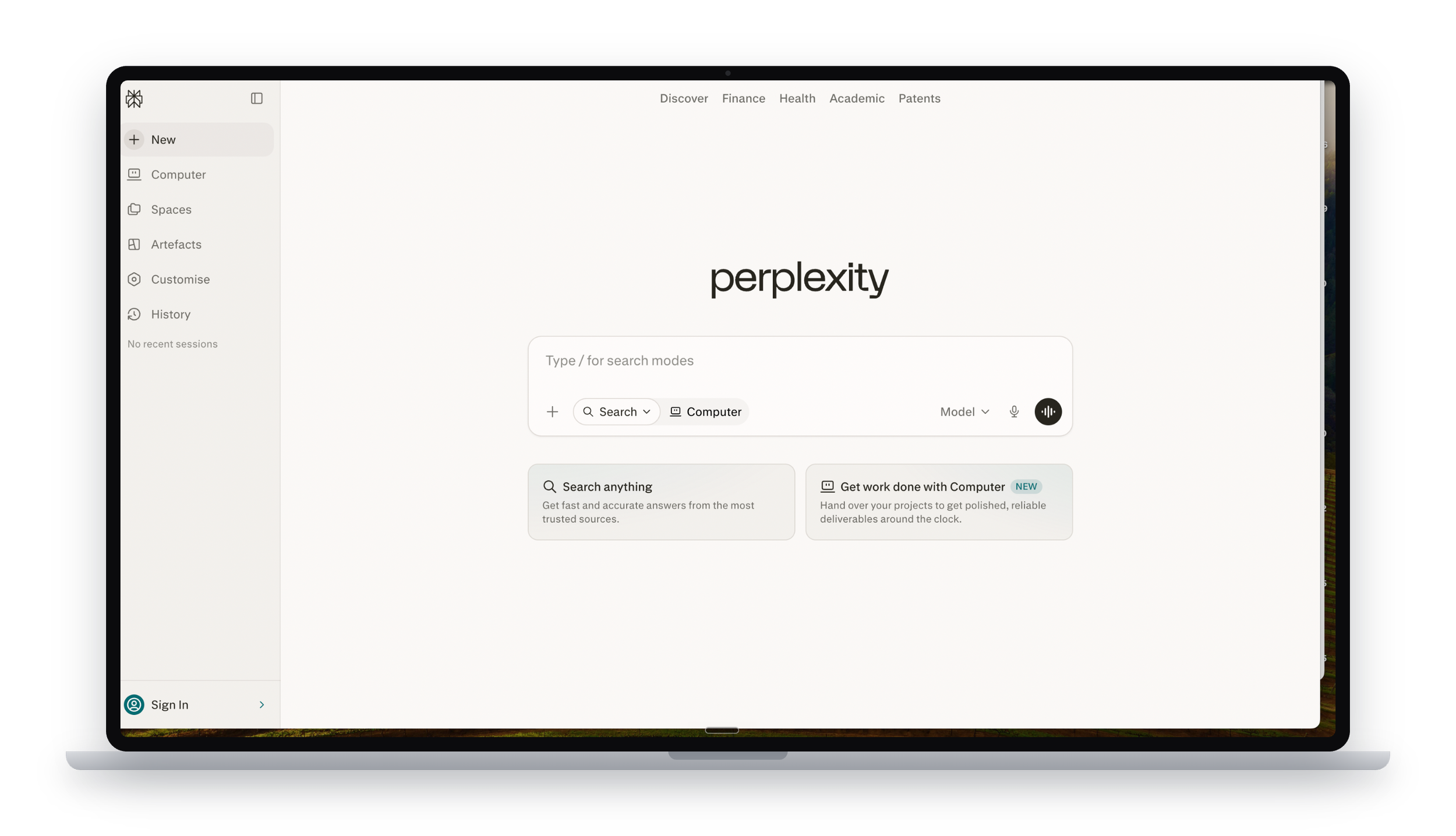
Perplexity is an answer engine. You ask a question, it searches the live web, and it hands back a synthesised answer with numbered citations you can click through to the source. Most replies carry five to ten of them, so you can check the claim rather than trust it.
Where it earns its place in your week is the homework before a pitch. You are not using it to find journalists, because your press database already does that and keeps the contacts verified. You are using it to source the stat that makes your angle land, and to read a journalist's back catalogue. Pull up a writer's last six months of features, see the thread that runs through them, and you stop guessing at what they cover. You pitch the thing they were always going to write next.
Treat it as the research desk. It finds the facts. It does not write the pitch.
Claude: your writing partner and organiser
Claude is the one to reach for when words matter. In the independent writing benchmarks this year it sits top for tone and voice, the model that needs the least cleanup and holds a voice best across a full piece. It drafts a genuinely good pitch, and it is excellent for the writing around one: your founder story, your About page, turning a feature you landed into a newsletter, a LinkedIn post in your own register. If you want pitch templates and the knowledge of what the press really want, PR Dispatch is the best place to write the pitch itself. If you would rather start from a blank page in your own voice, Claude is a strong alternative.
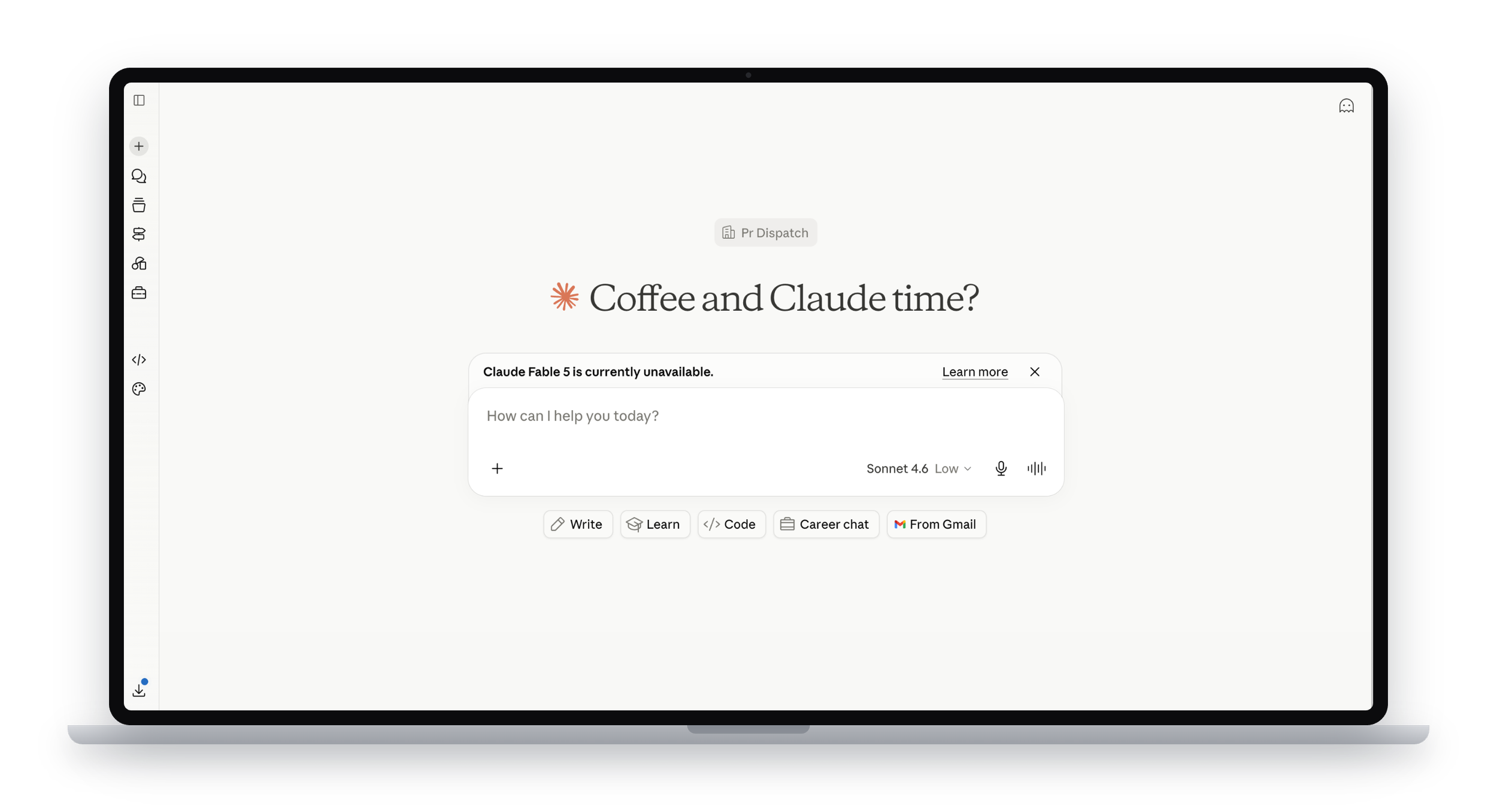
The trick is to feed it your brand. Give it your boilerplate, a few things you have written that sound like you, your actual turns of phrase, and it drafts in your register rather than generic AI tone that could be any brand. You will still tighten the final ten percent so it is unmistakably you, and that is the point. It gets you to the draft. You get it over the line.
Its other superpower is keeping you organised. The desktop app sits alongside your actual files, so you can have it name your product images and press assets properly and sort them into a simple system you can find in seconds. Less digging for the right photo, less friction when it is time to pitch.
Gemini: your AI search check
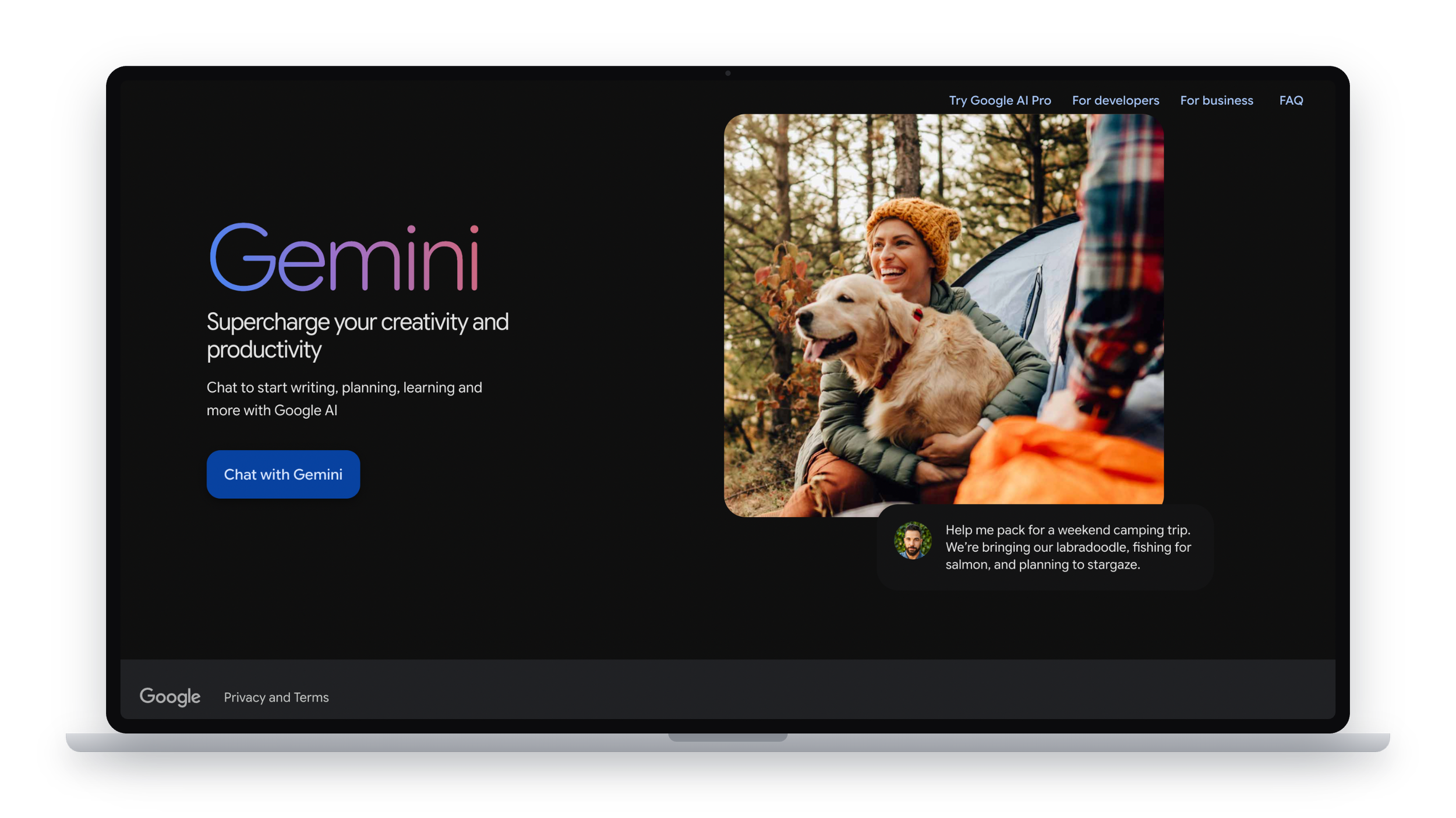
Gemini is Google's all-rounder, and its real advantage is where it lives. It is wired into Gmail, Docs, Sheets and the rest of Workspace, so if your whole working day already runs through Google, it has the most context on hand.
But in our opinion, for PR specifically, it is fine rather than essential. The job worth giving it is checking your AI search visibility. When someone asks an AI engine for a recommendation in your category, what comes back, and is it you? Gemini is a useful way to test how your website and brand read to AI, and to spot what to tighten so you surface when it counts. That matters more every quarter, because the brands quoted across the press are the brands these engines learn to recommend. Coverage compounds. Your visibility in AI search is downstream of it.
Useful for the website and brand check. Mid for the pitching itself.
ChatGPT: the capable generalist
ChatGPT is the one everyone has, and for general work it deserves the reputation. It will draft, summarise and brainstorm all day. We even give our members ready-made ChatGPT prompts inside the platform for researching a feature and tracking mentions, because for the broad strokes it does the job.
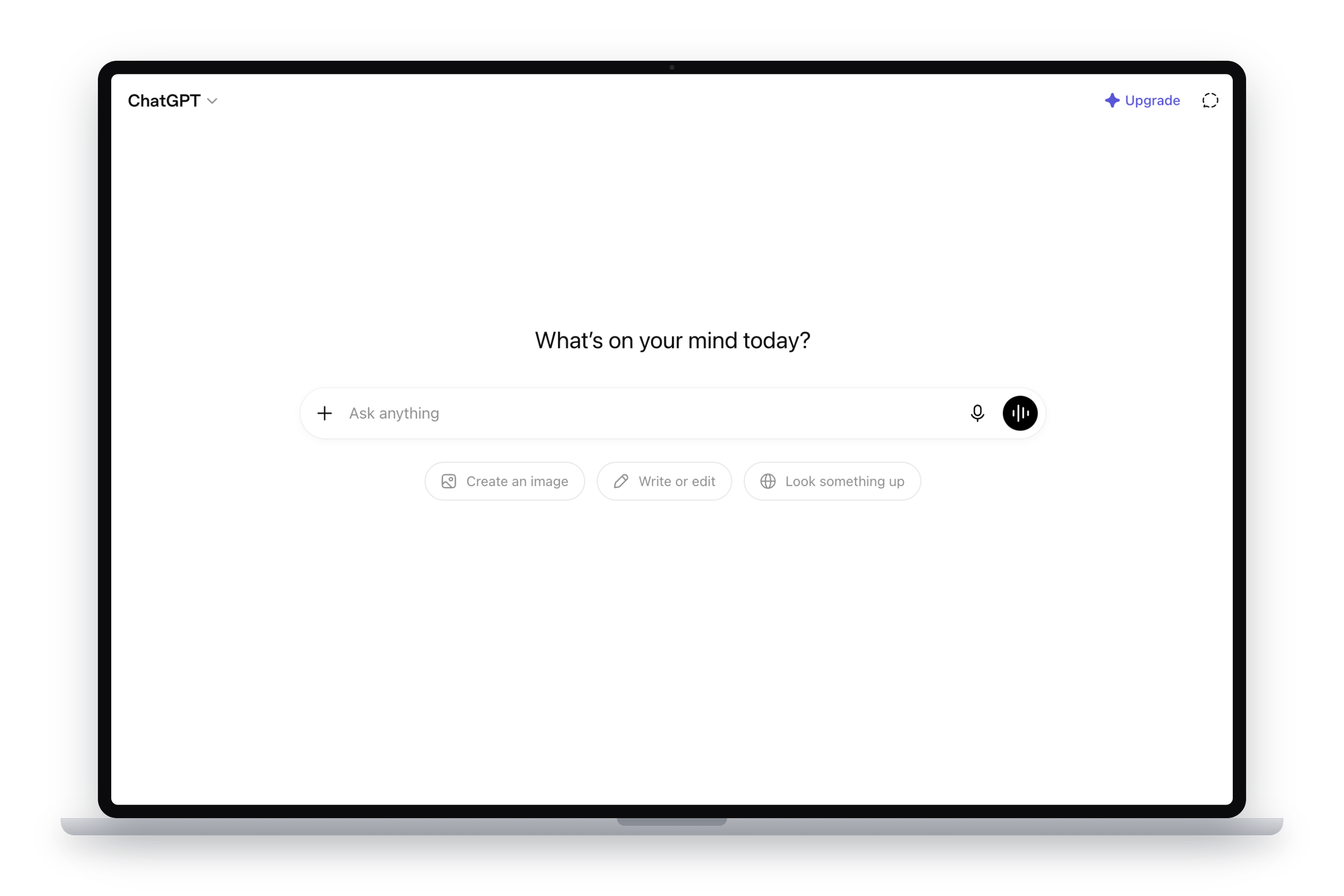
For PR it hits a wall, and the wall is knowledge. ChatGPT can write you a pitch in thirty seconds. It cannot tell you which editor at Stylist covers independent beauty, what their lead time is, or what they are working on this month. It does not know that Friday afternoons are a dead zone for sending, or what a gift guide editor needs by June. It writes confidently into a gap where the actual PR knowledge should be.
Which is exactly the line one of our members, Milly Maunder, drew:
"Your AI assistant is better than ChatGPT for hooks and subject lines."
Not because the writing is fancier, because it knows the work. For the record, we are team Claude, but if ChatGPT is your default it will hold its own, given enough context.
One genuinely useful side-job sits here too. Both ChatGPT and Gemini can knock the background out of a product shot for the cut-out imagery press often ask for, which saves you a separate Canva Pro or adobe subscription. Both are good options. At the time of writing ChatGPT has a slight edge on rendering accurate text, so if your product is text-heavy, busy packaging or a detailed label, that may be the one to reach for. Two rules either way. Only ever remove the background, never let the tool regenerate or retouch the product itself, and check the output before it goes anywhere: clean edges, true colour, and high enough resolution for print. A real product on a clean background is exactly what an editor wants. A slightly melted one is what gets you remembered for the wrong reason.
The PR Dispatch AI assistant: built for this one thing
Every tool above is brilliant at the thing it was built for, and none of them was built for PR. Ours was. Most AI defaults to the middle of the internet, the average of everything ever written. Ours is trained on the best in the business, and that is the difference.
The AI assistant inside the platform is trained on the PR Dispatch methodology and the full Academy, so when you ask it how to handle a follow-up or shape an angle, it answers from a decade-plus of editor relationships, not the open internet. The pitch builder runs on curated templates drawn from more than twenty years of knowing what journalists actually open and reply to, with editors like Susanne Norris at Stylist and Bex Burn-Callander at the Telegraph behind the masterclasses that inform it. The tracker turns ad-hoc pitching into a rhythm, freezing each contact at the moment you pitched so your records stay clean. The newsjacking angles tie live news to your specific brand. None of that lives in a general chatbot, because none of it can.
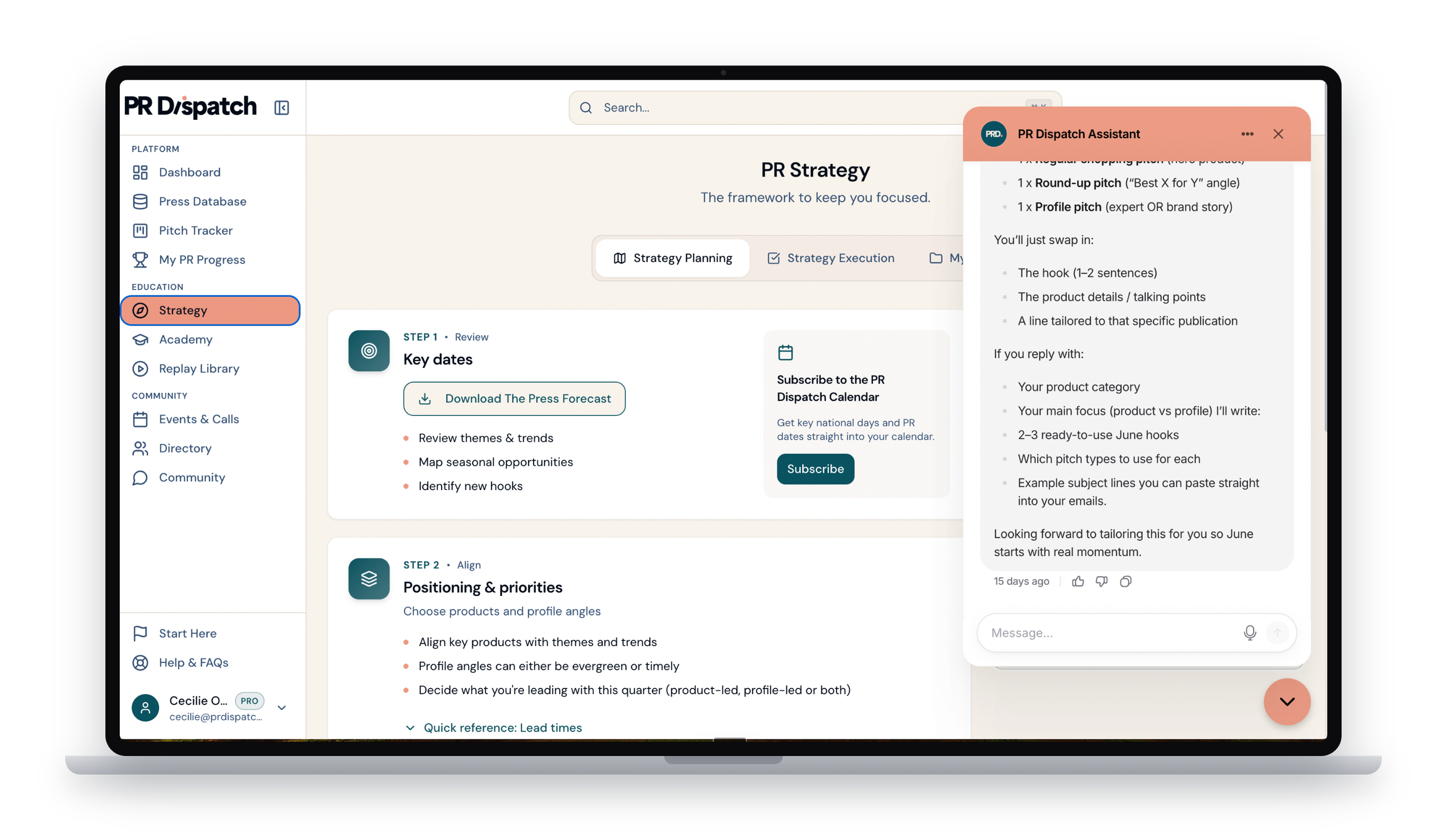
It does the unglamorous work fast. As one of our members at Holchester Designs put it: "I'm naturally wordy. Feeding my pitches through the PR assistant has been brilliant. It cuts things down and refines them fast. I'll still tweak the output so it sounds more like me, but it gets me to what I want to say so much quicker."
And it shows up from the first login. As a new member at Ooshky told us: "I'm generally not a fan of AI for many reasons, but the AI in the set up section did an excellent job. It somehow even got my founder story right even though I haven't finished my about page yet. The help chat was also really useful, which was refreshing. I think this should definitely help me be more consistent with my pitching."
That is the whole case. A general tool gives you a confident guess. A platform built on real editor knowledge gives you the answer, and the means to move those pitches from draft to a journalist's inbox.
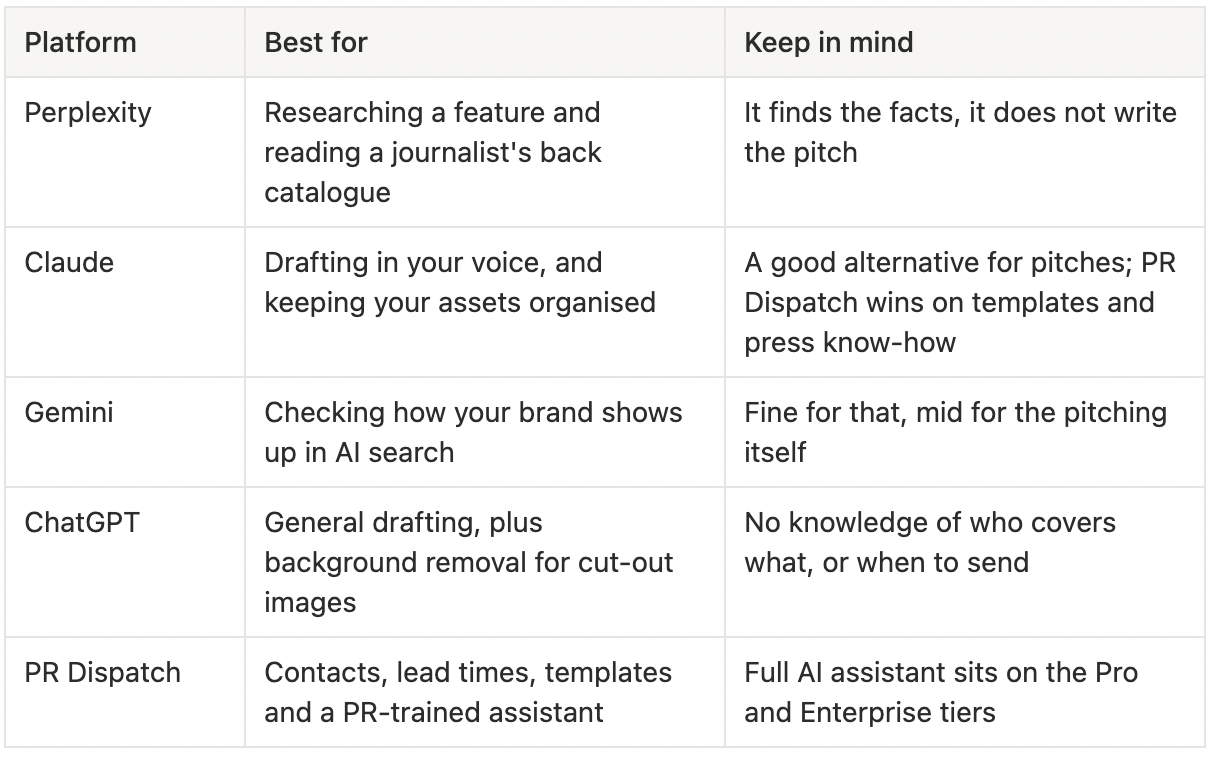
How they compare at a glance
Quick questions
What is the best AI tool for PR?
No single tool wins everything. Perplexity is best for research, Claude for writing pitches, Gemini for AI search visibility, and the PR Dispatch platform for the contacts and editor knowledge general tools do not have.
Which AI is best for writing press pitches?
For the pitch itself, the PR Dispatch pitch builder is the best, because it gives you templates and subject lines built on more than twenty years of what journalists open and reply to. Claude is a strong alternative if you prefer to draft from scratch in your own voice, and it is excellent for the writing around the pitch.
Can AI find journalists for you?
General AI tools cannot reliably tell you which journalist covers what, or their lead times. A curated, verified press database does that job, which is why PR Dispatch keeps one updated every week.
Is ChatGPT good for PR?
ChatGPT is a capable all-rounder for general drafting, and it can even remove the background from product images for press. It hits a wall on real PR knowledge though, like who to pitch and when to send.
Can you use AI to remove the background from product images for press?
Yes. ChatGPT and Gemini can both create clean cut-out images. Only ever remove the background, never let the tool alter the product itself, and check the result is sharp and high enough resolution for print.
The bottom line
You can keep stitching five tools together every week. Or you can do your PR in one place, in around two hours, at three percent of what an agency charges, with hundreds of other product brands already doing exactly that.
Less time on PR. More coverage. Powered by AI.
The PR Dispatch AI assistant isn't a generic chatbot. It's trained on 20 years of PR experience, built specifically for product and eCommerce brands. Try it alongside 1,000+ verified UK journalist contacts, pitch tools and expert support, all in one place.
See how it works and what's inside with our 3-minute demo.